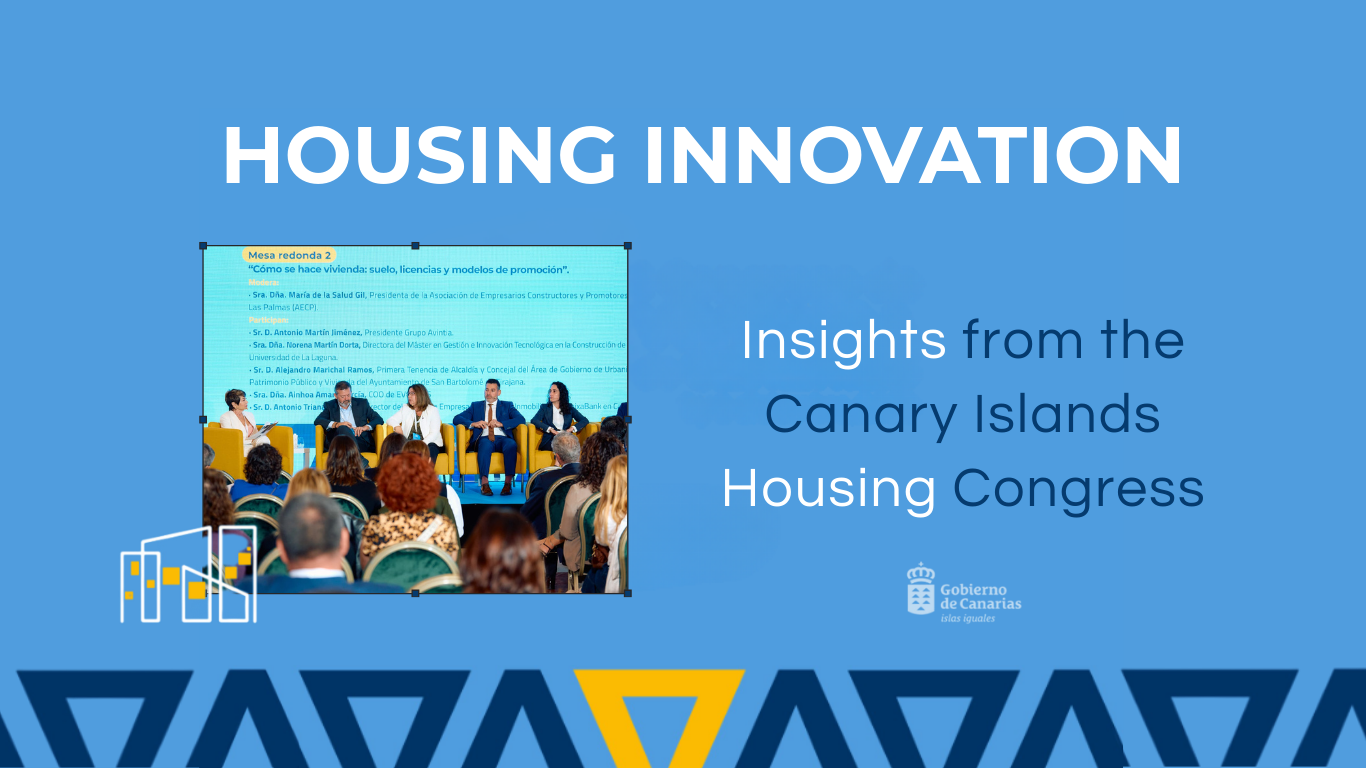
Housing innovation was positioned as a key enabler for delivering more efficient, inclusive, and sustainable housing policies. Construction industrialization was one of the main focuses of the 1st Canary Islands Housing Congress, organized by the regional government and ICAVI. The event brought together over 40 experts in Las Palmas to rethink the future of housing from an integrated perspective. Evocons participated in one of the key panels, sharing hands-on experience with the EvoConstructor robotic system for faster, more sustainable, and more efficient construction processes.
This event marked a pioneering effort by the regional administration to build a technical, social, and business dialogue space around how to guarantee the right to housing amid increasing demand, regulatory constraints, and the need for a transition to low-impact construction models.
Featured participation: Evocons in the panel “How Housing is Made: Land, Permits, and Promotion Models”
Our COO, Ainhoa, contributed Evocons’ technical and strategic vision alongside sector leaders such as Norena Martín Dorta (ULL), Antonio Triana (CaixaBank), Antonio Martín (Grupo Avintia), and Alejandro Marichal (San Bartolomé de Tirajana City Council), moderated by María de la Salud Gil (AECP).
The session emphasized the importance of articulating housing policies through innovation in housing, leveraging solutions that are already available and validated in real-world environments. EvoConstructor was presented as a real-world technology capable of addressing the speed, traceability, and sustainability challenges demanded by the new urban agenda.

1. Streamlining permits and land planning
The panel highlighted the need for territorial planning to accelerate timelines and ensure better access to developable land. A more integrated approach between public administrations and developers was proposed to activate housing projects with foresight and regulatory certainty.
In the Canary Islands, where land availability is influenced by geographic and environmental factors, revising urban planning frameworks emerged as a key takeaway. The integration of tools such as Geographic Information Systems (GIS) and predictive models was cited as a way to enable evidence-based urban decision-making.
2. New collaborative promotion and financing models
Speakers discussed mixed public-private promotion models to co-finance or co-manage affordable housing developments. These models can help scale sustainable solutions and mobilize underutilized land.
The municipality of Agüimes was highlighted as a case study on how public-private collaboration can enable pilot projects in robotic construction with tangible results. Tools such as program contracts, concessions, or public-social cooperatives were suggested to ensure efficient and transparent project development.
3. The role of industrialization and construction technology
Evocons highlighted EvoConstructor’s ability to reduce execution time by up to 4x, automate up to 60% of the construction process, cut on-site emissions, and deliver millimetric precision for complex tasks. Its applicability both on-site and in precast production enables new standards of efficiency and construction quality control.
The industrialization of construction was noted as a key strategy to structurally address the sector’s challenges: reducing timelines, ensuring consistent quality, and lowering environmental impact. The ability to replicate processes through technology and automation is what allows construction to move from manual methods to scalable, advanced production.
With validated use cases in real-world projects in Gran Canaria, EvoConstructor is positioned as a technology with direct impact on key performance indicators for developers and public bodies: lower total cost, better technical traceability, regulatory compliance, and reduced waste.
Its self-climbing adaptability for high-rise construction, and versatility for tasks such as 3D printing, structural casting, and finishing, make EvoConstructor an end-to-end solution adaptable to multiple scales and models.
4. Regulation, technical capacity, and innovation
There was broad consensus that transformation will only be possible if regulations are aligned with existing technical capacities and if a culture of innovation based on evidence and data is promoted.
Key advances mentioned included the recent approval of ISO/ASTM 52939 for additive manufacturing in construction (with Evocons contributing to its drafting), and the use of BIM methodologies for planning and construction oversight. These tools represent real housing innovation, enabling better, faster, and more technically and environmentally controlled construction.
Final thoughts: toward truly accessible and sustainable housing
The Congress marked a milestone as a dialogue platform to articulate real solutions to the Canary Islands’ housing challenge. At Evocons, we believe that collaboration between technology, policy, and urban planning is essential to ensure a more accessible, resilient, and climate-aligned housing stock. The industrialization of construction is undoubtedly a fundamental tool to achieve that.
Our commitment is to keep delivering validated technology like EvoConstructor to prove that construction 5.0 and housing innovation are not just possible—they’re already happening.