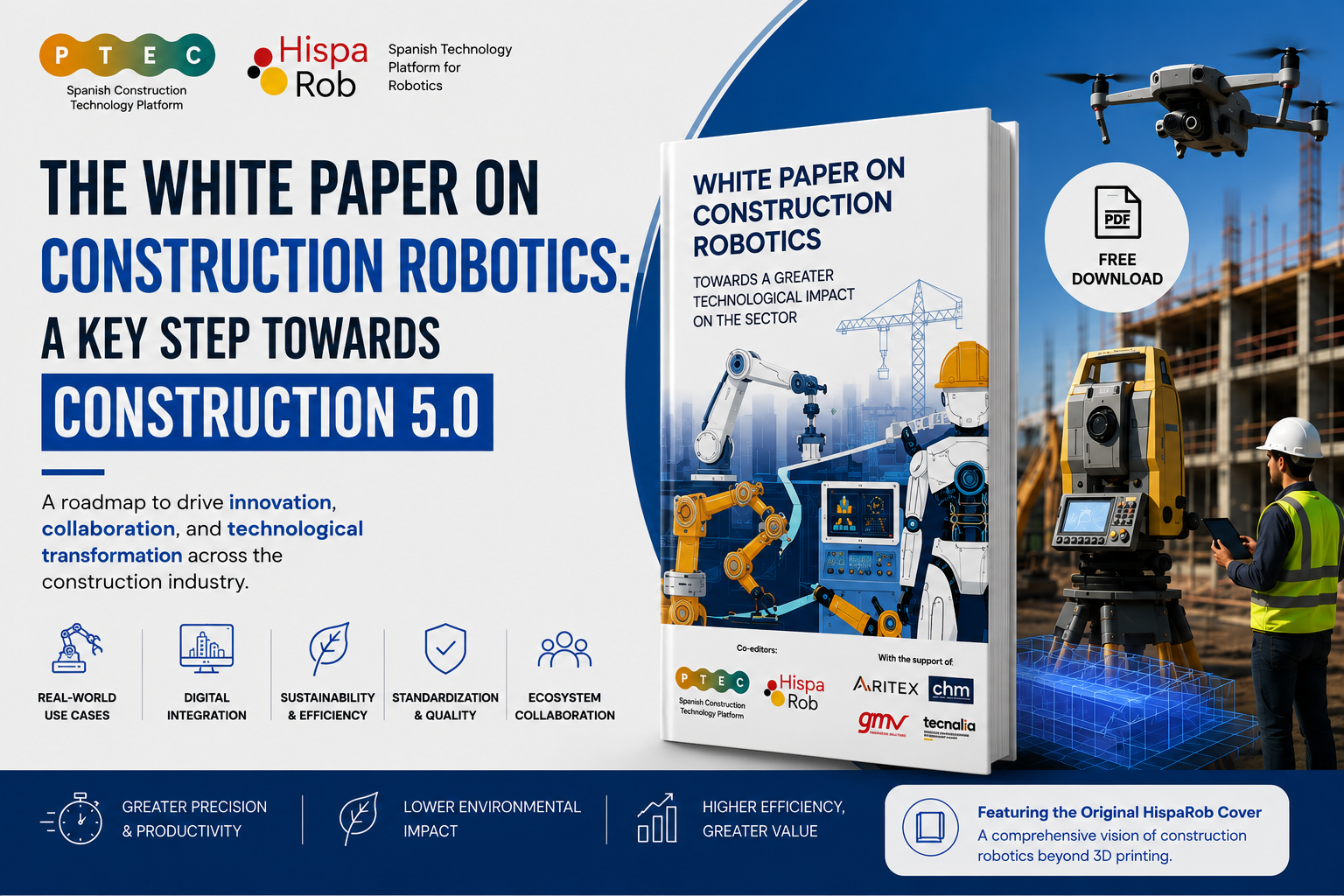
The White Paper on Construction Robotics marks an important milestone in the industry’s transition towards Construction 5.0. Developed by PTEC and HispaRob, the document highlights the growing role of robotics, automation, and digital technologies in creating a more efficient, sustainable, and industrialized construction sector.
This transformation is part of a broader shift reshaping the built environment. Technologies such as robotics, artificial intelligence, digital twins, and 3D printing are changing the way projects are designed, delivered, and managed, enabling more connected, data-driven, and productive construction processes.
By establishing a shared vision, common terminology, and a clear understanding of emerging technologies, the White Paper provides a strategic framework for companies, public administrations, and industry stakeholders seeking to accelerate the adoption of Construction 5.0.
What Does the White Paper on Construction Robotics Really Represent?
More than just a report, the document provides a shared strategic framework for the construction ecosystem.
Its objective is to offer a clear picture of the current state of robotics in construction, identify opportunities, and guide decision-making for both private companies and public administrations.
Key contributions include:
- A comprehensive overview of the current technological landscape
- Real-world use cases in building construction, civil engineering, and prefabrication
- Integration of robotics, AI, and digital systems such as BIM and digital twins
- Analysis of impacts on productivity, quality, and sustainability
- Identification of opportunities across the entire construction value chain
This approach enables the industry to move from isolated initiatives toward a coordinated transformation strategy.
Where Robotics Is Already Creating Value
The White Paper makes it clear that robotics is no longer a future promise, it is an expanding reality.
Some of the most relevant findings include:
- Productivity improvements of up to 35% in key tasks through collaborative robotics
- Significant reductions in construction errors
- Higher quality and repeatability, bringing construction closer to industrial manufacturing models
Robotics is already delivering value in several areas:
- Industrialized Construction and Prefabrication
Modular production in controlled environments enables more efficient and scalable construction processes while integrating advanced automation technologies.
- On-Site Construction
Robotic systems can perform complex tasks with greater precision, particularly in challenging and variable site conditions.
- Inspection and Maintenance
Drones, mobile robots, and advanced sensing technologies are transforming infrastructure monitoring and asset management.
A Paradigm Shift: From Construction 4.0 to Construction 5.0
The document positions the industry in a transition from Construction 4.0, focused primarily on digitalization, toward a new model where intelligent robotics and artificial intelligence play a central role.
This new paradigm is characterized by:
- Integration of autonomous and collaborative robots
- Extensive use of real-time data
- Convergence between industrial manufacturing and construction
- Stronger focus on sustainability and resource efficiency
In this context, robotics evolves from being a specialized tool into a fundamental component of the construction process itself.
Evocons’ Role in This Ecosystem
At Evocons, this evolution is seen as a strategic opportunity to advance a more intelligent, scalable, and sustainable construction industry.
The company contributes actively to this ecosystem through technologies such as EvoConstructor®, a multifunctional robotic platform that integrates:
- On-site 3D printing
- Automated structural concrete pouring and leveling
- Robotic finishing operations
- Vertical construction through self-elevating systems
These capabilities can deliver:
- Up to 30% cost savings
- Up to 40% CO₂ emissions reduction
- Construction processes up to four times faster
All aligned with the core principles promoted by the White Paper: industrialization, automation, and sustainability.
A Framework for Action, Not Just Analysis
One of the White Paper’s greatest strengths is that it goes beyond describing the current landscape and actively promotes action.
The document recommends:
- Strengthening collaboration between technology providers and construction companies
- Expanding training in robotics, AI, and automation
- Aligning innovation with regulations and international standards
- Encouraging new industrialized construction business models
Ultimately, it lays the foundation for a coordinated transformation of the sector.
Access the Resource
📥 Download the White Paper on Construction Robotics
Conclusion: A Roadmap for the Future of Construction
The publication of the White Paper on Construction Robotics represents a significant milestone for the construction industry.
It not only confirms that robotics is becoming an increasingly important reality, but also provides a structured and shared vision of how the sector can move forward.
For construction companies, developers, manufacturers, and public administrations, this document offers an opportunity to:
- Make strategic decisions based on evidence
- Adopt emerging technologies with greater confidence
- Become part of a rapidly evolving innovation ecosystem
At Evocons, we see this initiative as a key step toward consolidating Construction 5.0, where robotics, 3D printing, and data-driven systems enable the industry to build better, faster, and more sustainably.
Frequently Asked Questions
What is the White Paper on Construction Robotics?
It is a strategic document that analyzes the current state of robotics adoption in construction and proposes a roadmap for its implementation.
Who is leading this initiative?
The Spanish Construction Technology Platform (PTEC) and HispaRob, together with more than 200 organizations across the innovation ecosystem.
Why is it important now?
Because the construction sector is moving toward more industrialized models and requires common frameworks for technology adoption.
What benefits does robotics bring to construction?
Higher productivity, improved quality, reduced errors, and better resource optimization.
How does robotics impact prefabrication?
It enables automated modular production, improving efficiency, consistency, and scalability.
How does it differ from traditional construction methods?
Robotics introduces automated, data-driven, and repeatable processes that increase predictability and performance.
What should companies do next?
Evaluate relevant use cases, adopt technologies progressively, and align innovation efforts with industry standards and best practices.