3D-Printed Concrete Urban Furniture Integrated into Public Works with Local Production and Coastal-Adapted Design
3D Concrete Printing Enters Public Urban Development
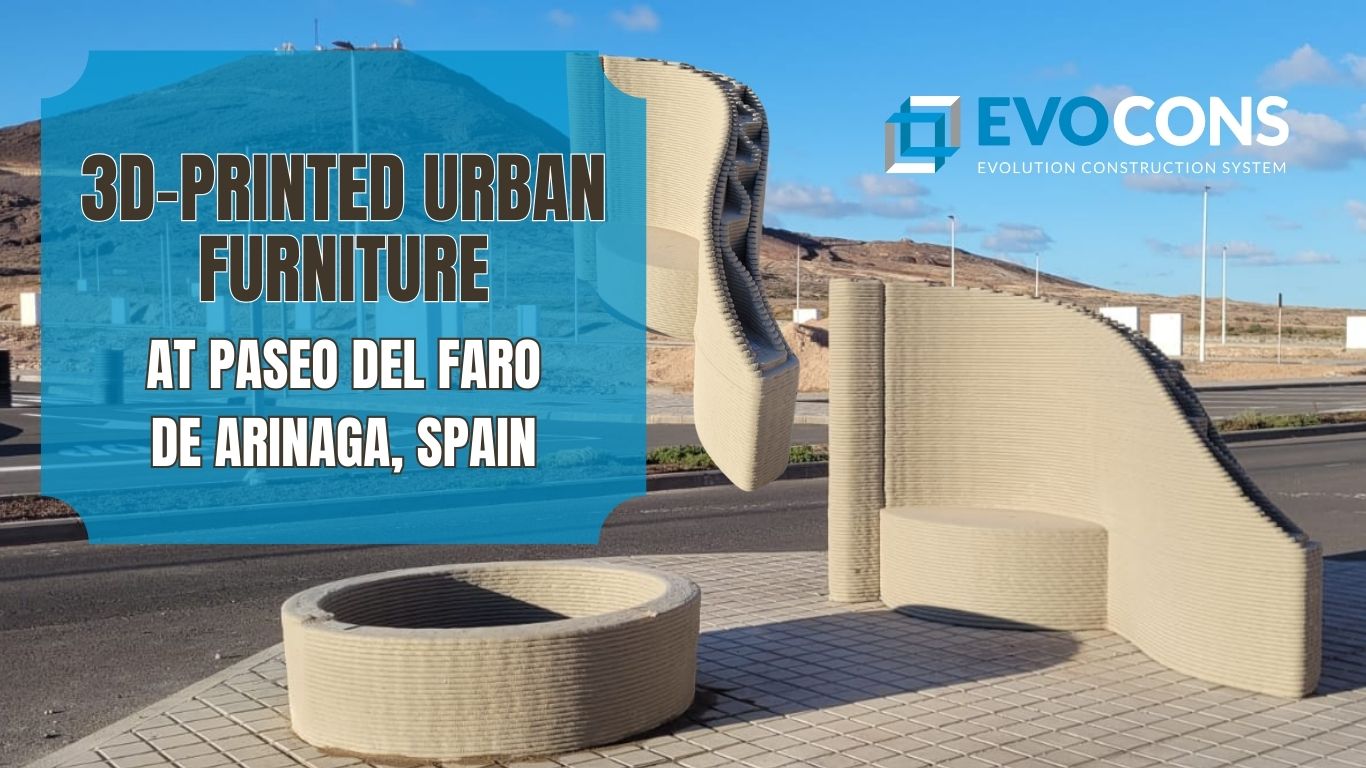
The Paseo del Faro de Arinaga renovation marks a milestone in Spain’s public infrastructure sector. For the first time, 3D-printed urban furniture has been incorporated into a municipal urban improvement project using additive manufacturing in concrete.
This initiative transforms Paseo del Faro de Arinaga into a real-world case study of how 3D concrete printing can be successfully integrated into public works, combining digital technology, automation, and local production.
The City Council of Agüimes (Las Palmas) included in its public tender the requirement that specific elements, benches and planters, be produced using additive manufacturing, ensuring the integration of advanced construction technologies into a real urban development project.
Technical development and fabrication were carried out by EVOCONS, developer and manufacturer of robotic technology for Construction 5.0, in collaboration with Prearsa, a Canary Islands–based precast specialist that has integrated 3D printing and robotics into its industrial production process.
Why Incorporate 3D-Printed Urban Furniture in Public Infrastructure Projects?
The municipal project included:
- Sidewalk widening
- Removal of architectural barriers
- Parking reorganization
- Comprehensive public space renovation
Within this broader intervention, 3D concrete printing was evaluated as a strategic technological alternative to enhance efficiency and adaptability.
Specifically, additive manufacturing enabled the project team to:
- Optimize production timelines
- Eliminate traditional molds and formwork
- Develop geometries adapted to coastal environmental conditions
- Maintain cost control in short production series
Through the use of EvoConstructor®, additive manufacturing makes it possible to produce customized or unique pieces without incurring additional mold-related costs. This capability is particularly valuable in singular urban projects that require contextual adaptation, budget predictability, and geometric precision.
Additive Manufacturing Applied to 3D-Printed Urban Furniture Design
The urban furniture elements were extruded in concrete using a fully digitalized system capable of controlling each printed layer with millimetric precision.
Key Technical Features
Environmentally Adapted Geometries
The pieces incorporate forms specifically designed to redirect prevailing winds in Arinaga, improving user comfort in a coastal setting.
Automated Precision
Robotic fabrication guarantees fidelity to the digital model, minimizing geometric deviations and ensuring consistency between design and execution.
Performance in Marine Environments
Materials and thicknesses were engineered to withstand salinity and atmospheric agents typical of coastal environments, ensuring long-term durability.
The planters were designed according to the specific requirements of the selected plant species, while the benches integrate ergonomic criteria and wind mitigation strategies. The design process was carried out in coordination between the Municipal Technical Office of the City Council of Agüimes and the EVOCONS technical team.
Local Production and Industrial Integration
A key aspect of the project was the collaboration between EVOCONS and Prearsa, enabling full production of the 3D-printed urban furniture within the Canary Islands.
This local integration contributed to:
- Reduced interregional logistics
- Incorporation of locally sourced raw materials
- Optimized delivery schedules
Beyond logistical advantages, additive manufacturing provided additional benefits:
- Elimination of conventional molds and formwork
- Reduction of waste and material surplus
- Digital optimization of material consumption
- Economic viability in short production runs
These capabilities reflect EVOCONS’ technological approach, based on automation, precision, and sustainability within the Construction 5.0 framework.
A Case Study for Future Urban Applications
Inaugurated on December 1, 2025, the installation represents a practical benchmark for Public Administrations, developers, and urban planning professionals interested in evaluating the application of 3D-printed urban furniture in public spaces.
The project offers measurable insights into:
- Performance under coastal environmental conditions
- Production efficiency through digital workflows
- Integration with prefabrication processes
- Scalability potential for future urban furniture and singular architectural elements
The Paseo del Faro de Arinaga experience positions additive manufacturing as a viable and scalable tool for the evolution of public urban infrastructure in Spain.
Towards a New Generation of Digital Urban Infrastructure
As cities transition toward more digital, efficient, and sustainable development models, the implementation of 3D-printed urban furniture at Paseo del Faro de Arinaga demonstrates that additive manufacturing is no longer experimental, it is operational.
This project highlights how parametric design, robotic automation, and local industrial ecosystems can work together in alignment with municipal technical teams. Beyond technological innovation, it opens new opportunities in urban customization, resource optimization, and digitally planned infrastructure.
By integrating 3D concrete printing into public works, this initiative contributes to the broader evolution toward Construction 5.0, where automation, sustainability, and precision redefine how cities are built and improved.