Automated construction is no longer a future concept, it is an operational reality that is redefining how buildings are designed, executed and monitored. The transition toward Construction 5.0 combines efficiency, sustainability, digital control and human–robot collaboration to create safer, more precise and more accessible construction environments.
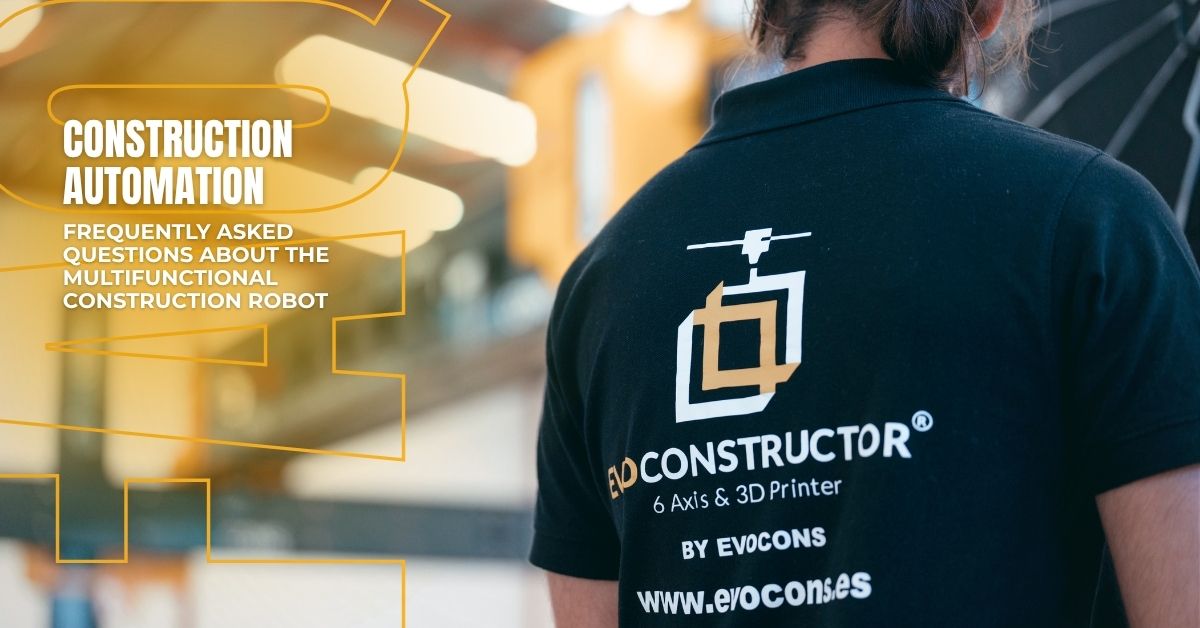
The EvoConstructor® multifunctional robot, developed by Evocons and validated in real projects, is one of the technologies accelerating this shift while expanding access to technical roles by reducing reliance on intensive physical tasks.
Below are the most common questions from companies, public administrations and technical teams evaluating this technology.
What is the multifunctional robot and what makes it unique?
EvoConstructor® integrates industrial robotics, artificial intelligence and digital control into a single system capable of automating multiple phases of the construction process. Unlike traditional 3D-printing machines, it combines structural casting, on-site 3D printing, leveling, plastering, tiling, insulation application and finishing in one modular Plug & Play unit.
Its self-elevating system enables safe operation at height without cranes or scaffolding while maintaining millimetric accuracy and consistent results.
By minimizing repetitive physical loads, the robot also expands access to qualified operational roles, supporting greater diversity and equal opportunities within construction teams.
Which processes can it automate?
The system can automate up to 60% of the construction workflow, covering both structural elements and finishing tasks.
Its modular design allows quick tool changes, often in minutes, so the robot can adapt to the specific needs of each project.
This flexibility also enables architects and designers to apply bioclimatic principles and site-specific geometries without increasing manual workload, enhancing project adaptability across climates, plots and uses.
How long does installation take?
A full installation requires 3 days, followed by 1 day of calibration.
By day five, the system is fully operational with a three – technician team.
Its modular structure makes it suitable for both on-site deployment and industrialized prefabrication lines, without the need to redesign existing production layouts.
What savings does it provide compared to traditional methods?
Integrated automation allows companies to achieve:
- Up to 30% reduction in total execution costs
- 25% reduction in indirect costs
- Up to 50% shorter construction timelines
The use of local materials (from €0.01/kg) enhances cost efficiency and reduces the environmental footprint associated with logistics.
What types of projects can it execute?
EvoConstructor® can be used in residential buildings, public infrastructure and industrialized prefabrication.
Its scalable dimensions, from 3 × 3 × 4 m to 24 × 40 × 40 m, allow it to support single-family homes, multi-storey buildings and large structural components.
What maintenance does it require and what warranty does it include?
The robot is designed for continuous operation with low maintenance requirements.
Daily cleaning, basic calibration and weekly verification can be carried out by the on-site team.
A preventive technical review with software updates is recommended every six months.
It includes a 2-year full warranty plus an essential spare-parts kit to ensure continuity of operations.
What sustainability and operational benefits does it provide?
Thanks to high-precision execution, digital monitoring and optimized material usage, the robot enables:
- Up to 80% reduction in CO₂ emissions
- Up to 60% reduction in construction waste
- Full traceability and digital control of all building phases
These capabilities support a sustainable and accessible industrialization model, adaptable to different business structures without compromising design quality.
How can companies integrate this technology?
Technology adoption occurs progressively. Evocons provides technical training, on-site support and operational guidance.
The system integrates into existing workflows with minimal disruption and allows companies to scale digitalization at their own pace, strengthening resilience, operational stability and long-term competitiveness.
Conclusion
Automated construction is a strategic driver of industrial transformation.
EvoConstructor® demonstrates that it is possible to industrialize on-site workflows without sacrificing design flexibility, while improving cost efficiency, sustainability and equitable access to technical roles.
Organizations that adopt this technology position themselves as leaders in the evolution toward Construction 5.0.