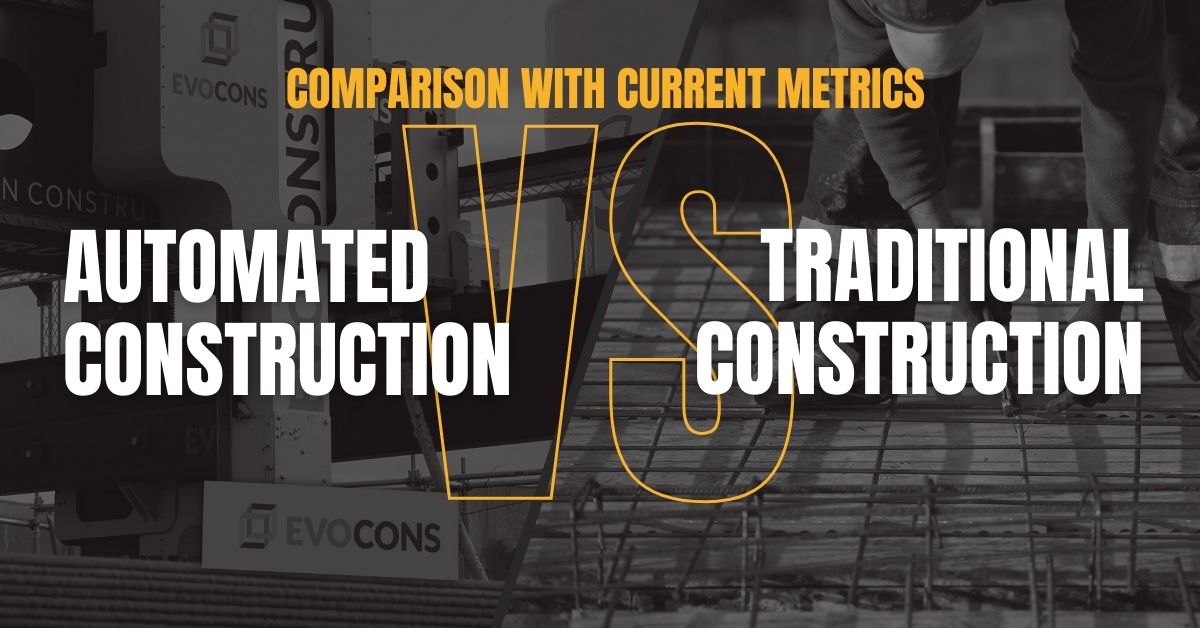
Automated Construction or Traditional Construction? Which Method Performs Better in Cost, Time, and Sustainability?
This article presents a real-world comparison between traditional construction methods and Evocons’ robotic solution, based on current metrics. It explains how automating finishing tasks can lead to more efficient, sustainable, and data-driven building processes.
Introduction: From Delay to Construction Transformation
The construction industry faces a critical challenge: continue relying on slow, costly, and error-prone traditional methods, or adopt a digital transformation that improves performance across all key indicators.
According to McKinsey (2023):
- 79% of large-scale construction projects experience cost overruns.
- Delivery timelines exceed initial estimates by an average of 52%.
This highlights the need to evolve toward smarter construction models, using technology to enhance control, precision, and sustainability across all project phases.
The Bottleneck: Finishing Tasks Drive Costs and Delays
Beyond structural execution, final finishing stages, such as plastering, tiling, surface rendering, and leveling, represent:
- Up to 30% of total construction costs in traditional projects.
- High levels of rework due to manual errors.
- Delays related to specialized labor and weather conditions.
These repetitive, manual tasks become a bottleneck that limits project efficiency and predictability.
Current Solutions: Partial vs Full Automation
There are two main technological approaches to modernizing on-site construction:
1. Partial Automation (including traditional 3D printing)
This category includes solutions that automate specific phases, such as structural 3D printing or concrete pouring. However, they often:
- Have material and geometric limitations.
- Do not cover finishing stages or enable real-time BIM integration.
- Lack full digital traceability and predictive capabilities.
2. Full Automation with a Multifunctional Robot: EvoConstructor®
Evocons has developed an integrated system that:
- Automates up to 60% of on-site construction activities.
- Covers 3D printing, pouring, leveling, and finishing.
- Captures metrics in real time and applies AI optimization.
- Adapts to both on-site and off-site (prefabricated) environments.
EvoConstructor®: Intelligent Construction Technology
EvoConstructor® enables a Construction 5.0 approach by combining automation, digitalization, and sustainability. The system:
- Captures metrics related to progress, material usage, and productivity.
- Integrates with BIM and 3D models in real time.
- Optimizes project schedules and resource consumption using algorithms.
- Creates a living digital twin for simulation and proactive planning.
Real-World Comparison: EvoConstructor® vs Traditional Methods
| Metric | Traditional Methods | EvoConstructor® |
| Execution Costs | High, variable | Up to 30% lower |
| Construction Time | Slow, sequential | 4x faster |
| On-Site Precision | Manual, error-prone | Millimetric, robotic execution |
| CO₂ Emissions and Waste | High | Up to 40% less |
| Traceability and Control | Paper-based, limited | Digital and real-time |
| Predictive Capabilities | Reactive | Scenario simulation using AI |
| BIM Integration | Partial or missing | Full and real-time |
Data as a Lever for Change
A printed blueprint is static. A digital dataset is dynamic. Digitalization in construction enables:
- Full traceability across all project phases.
- Predictive intelligence for scheduling and logistics.
- Evidence-based decision-making.
- Sustainability monitoring, including carbon footprint and waste metrics.
At Evocons, industrialization means digitalization. Data is the foundation for transforming how we build.
Live 3D Modeling: The Digital Twin On-Site
EvoConstructor® generates a live 3D model that evolves throughout the construction process:
- Real-time updates on progress, material consumption, and deviations.
- Simulation of future phases for risk reduction and schedule improvement.
- Synchronization between technical office and site for faster, data-backed decisions.
BIM Integration Advantages
When integrated with BIM:
- Seamless collaboration across design, execution, and development.
- Granular analysis of geometry, materials, and timelines.
- Enhanced foresight to prevent cost overruns.
Full Process Automation and Control
EvoConstructor® digitalizes and automates the construction process from start to finish:
- Tracks m² executed, materials consumed, and on-site productivity.
- Operates within a digital ecosystem connected to BIM.
- Uses algorithms to optimize energy and resource use.
- Offers interoperability with planning, cost, and ESG systems.
Applied Intelligence in Every Project
Every captured metric becomes actionable insight:
- Pattern detection and predictive analysis.
- Context-specific project adaptation.
- Support for ESG compliance.
- Reduction of hidden costs and improved profitability.
Conclusion: Building with Data and Automation
Digitalization is no longer optional. It is essential for achieving efficiency, sustainability, and long-term resilience in the built environment.
EvoConstructor® enables this shift with validated automation technology, real-time performance metrics, and proven outcomes that drive construction industrialization.
Learn How EvoConstructor® Can Improve Your Projects
Contact our team to schedule a personalized demonstration. Discover how automation can enhance productivity, reduce costs, and meet sustainability goals.