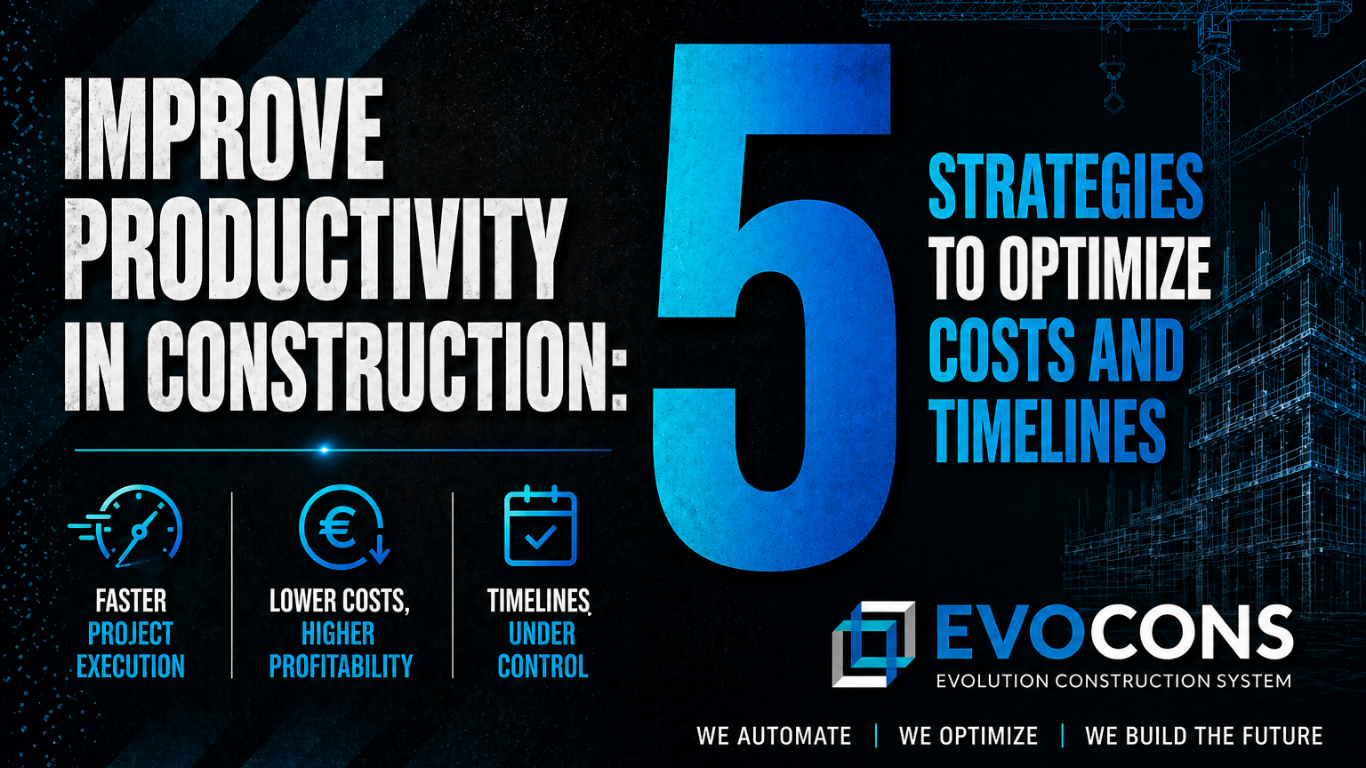
Improve productivity in construction is a critical priority for companies facing increasing pressure on costs, timelines, and efficiency.
Construction productivity has historically been one of the sector’s main issues.
According to the McKinsey Global Institute, productivity in construction has grown by only around 1% annually over recent decades, significantly lagging behind other industries.
However, this scenario is beginning to change.
The integration of construction process automation, robotics, and 3D printing is enabling a shift toward more efficient, scalable, and predictable models.
Below, we explore five real strategies that are already improving productivity on construction sites.
1. Construction Process Automation
Automation is one of the key drivers of productivity in construction.
It enables repetitive tasks to be executed with greater precision, reduces execution time, and improves overall project efficiency.
Real Applications
- Automated concrete pouring and leveling
- Robotic execution of finishing works
- Digitized repetitive processes
Systems such as multifunctional robots allow multiple phases to be integrated into a single workflow, reducing operational friction.
According to the World Economic Forum, adopting automation and digital technologies in construction can increase productivity by 14% to 15%, while also reducing costs and project timelines.
2. Industrialization and Prefabrication
Industrialization shifts part of the construction process to controlled environments.
This allows for:
- Greater quality control
- Reduced construction time
- Optimized material usage
The combination of prefabrication and automation is creating more productive and scalable models.
It also enhances repeatability, one of the key factors in improving efficiency.
3. Digitalization and Data-Driven Management
Productivity improves when decisions are based on real-time data.
Key technologies:
- BIM (Building Information Modeling)
- Digital construction management platforms
- Sensors and monitoring systems
These tools not only help anticipate deviations but also optimize resources and improve coordination between teams. Furthermore, digitalization connects all phases of the project, from design to execution, creating a more efficient, integrated workflow based on real-time data, enabling faster decision-making, reducing errors, and enhancing overall project visibility and performance.
4. Integration of 3D Printing in Construction
3D printing in construction enables the production of components directly on-site or in controlled environments.
Benefits:
- Waste reduction
- Greater design flexibility
- Optimized material usage
Additionally, it integrates design and execution into a single digital workflow, reducing errors and construction time.
According to various industry studies, additive manufacturing is expected to significantly transform construction efficiency in the coming decade.
5. New Operational Models: Construction 5.0
The greatest productivity gains do not come from a single technology, but from their integration.
Construction 5.0 combines:
- Robotics
- Artificial intelligence
- Automation
- Digital fabrication
This approach transforms construction sites into connected production systems where processes are digitally coordinated, tasks are automated when they add value, and efficiency and sustainability are continuously optimized.
This model is already being developed by innovative companies such as Evocons, which integrate robotics, AI, and 3D printing into advanced construction systems.
Conclusion: From Incremental Improvement to Structural Transformation
Improving productivity in construction is no longer about isolated optimizations.
It represents a fundamental shift in the industry.
Companies adopting:
- Automation
- Digitalization
- Industrialization
Are achieving clear competitive advantages in efficiency, control, and scalability.
The transition toward Construction 5.0 is not a future trend, it is already underway.
Improving productivity in construction also means addressing one of the sector’s biggest challenges: the shortage of skilled labor. The adoption of technologies such as robotics and automation not only enables more precise execution but also reduces dependence on labor-intensive processes. This allows companies to maintain quality and timelines even in talent-scarce environments, while improving safety and optimizing resource use.
Want to improve the productivity of your construction projects?
Discover how a multifunctional construction robot can optimize time, costs, and quality.
Request more information about EvoConstructor®. Schedule a personalized demo